When we got tickets for the evening experience at Te Puia, tickets for the daytime were included for free. So, we decided to go back the next day. First, though, we went to Wai-o-tapu to see the Lady Knox geyser and the rest of the “thermal wonderland.”
The Lady Knox geyser has an eruption cycle of 24-72 hours, but to make it erupt more regularly park workers put a soap-like substance into it to break down the surface tension, making it erupt every day at 10:45. It was pretty cool to see and was going off for over 10 minutes before we decided to head on to the rest of the park.
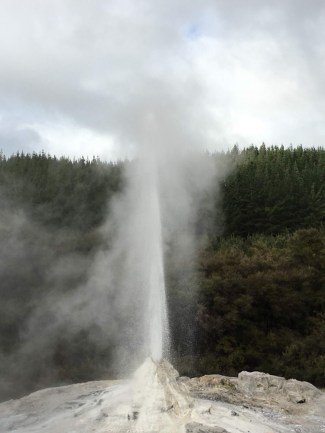
Lady Knox Geyser
Rotorua is known as an area with lots of geothermal activity (you can definitely tell from the smell of sulfur in the air), so you can find hot mud springs and geysers in many places. Wai-o-tapu is known for its bright, colorful pools which makes it a little more unique. There was one area called the Artist’s Palette, where there was a huge pool that was different colors in different sections depending on what minerals are found there. One of my favorite spots, though, was Devil’s Bath. It was the first pool we came to and was neon lime green. It was so bright, it didn’t look natural even though it is only changed that color by the sulfur in the water.


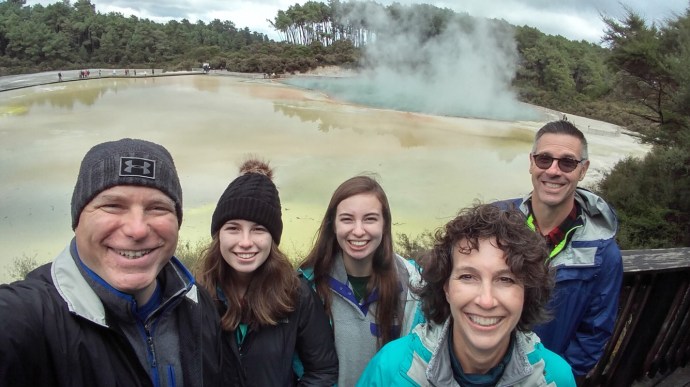
After walking through Wai-o-tapu and taking all the different colors of steaming and bubbling pools, we drove back to Te Puia. There, we were just in time to join a guided tour of the cultural center and geothermal park. Our tour guide was very nice and because we were in a small group, he got to take us all around and tell us more about Maori art, history, stories, and culture.


One thing that is very unique about Te Puia is that there is a school there that teaches people of Maori descent the arts of jade and bone carving, wood carving, and basket weaving. We even got to go into the school and watch some of the students working, which was really cool. I would love to try one of these amazing crafts (stay tuned for my blog post in Fiji). There was a small kiwi house at Te Puia as well, but the kiwis weren’t too active so we didn’t really get to see them.


The end of our tour was by the geysers that we had looked at the night before, but now we were waiting for Pohutu, the big geyser, to erupt. The signs showed that it would happen soon, so we waited for a few minutes and sure enough, it did erupt. It was pretty impressive how high it was, so I was glad we were lucky enough to see it. Unlike the Lady Knox geyser, Pohutu is not induced so you can’t predict when it will go off.
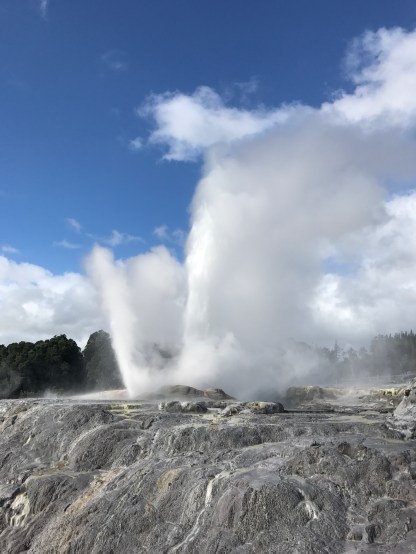
Pohutu and Prince of Wales Geysers
After our tour had finished and we had seen a lot of Te Puia, we had to get in the car to drive north about three hours to the Coromandel Peninsula, where we would be staying that night. We stayed at a place called the Church Accommodation, which was actually an old church that was turned into a hotel (although we were staying in the house off to the side of the church). That night we had dinner at the Pour House, the only restaurant in the small town of Hahei that was still open when we got there and everyone really enjoyed it- a great end to a busy day!
 Hammond Adventures